




Charter schools operate independently of local school districts. They have greater flexibility than traditional public schools in curriculum, schedule, teacher hiring and development, allocation of resources, and other areas. Like traditional public schools, charter schools are funded by tax dollars. They are subject to health, safety, and other state and federal regulations. In many states, like Utah, charter schools must submit detailed annual reports to their authorizers, including financial audits and budgets, enrollment, attendance, demographics, and facilities.
Public charter schools have several unique features that set them apart from traditional public schools:
- Charter schools often have increased autonomy in decision-making, including curriculum choice, staffing, and teaching methods.
- Charter schools may serve their students better because their class sizes are often smaller. They can innovate and make decisions that best serve students. For example, they may add a mentoring class where students who are struggling in a subject can get personalized help.
That same flexibility extends to specialized curricula or teaching methods. Many charter schools offer specialized STEM, visual and performing arts, sports, or Career and Technical Education (CTE) programs. CTE is an education pathway that provides students with the academic, technical, and real-world knowledge, skills, and experience they need to be prepared for a variety of career options.
Finally, charter schools are directly incentivized to meet performance goals: accountability. As part of their operating charter, these schools agree to meet specific academic and operational performance goals. Failure to meet these goals can result in the revocation of their charter. This pushes charter school operators to innovate and focus intently on achievement and accountability.
Public Charter Schools vs. Traditional Public Schools
Public charter and traditional public schools aim to provide students with free, high-quality education. However, there are some key differences between the two models:
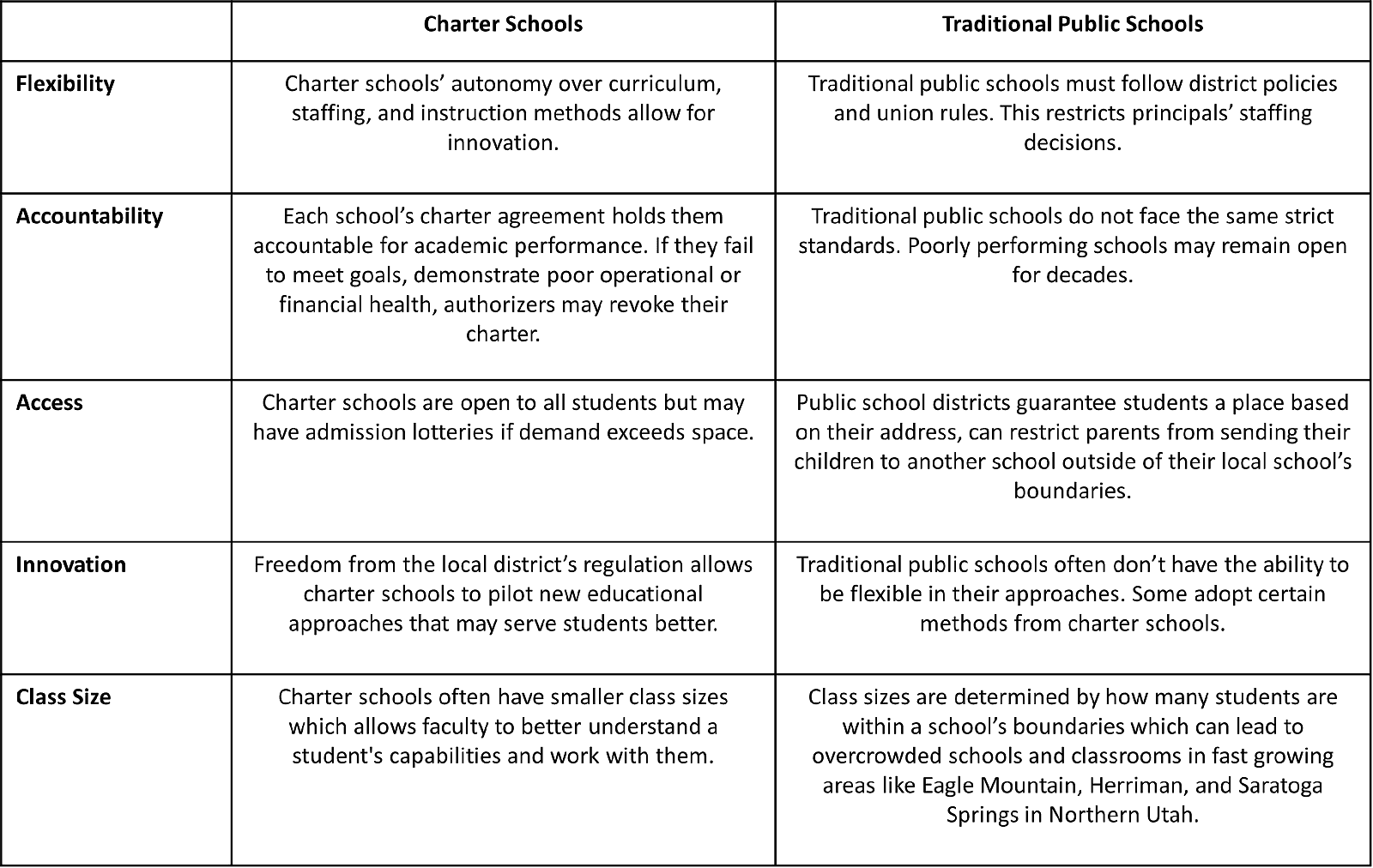
How Charter Schools Work
Charter schools follow a unique process that gives them more autonomy while holding them accountable for their performance. Most charter schools operate according to the following principles:
Charter Application and Approval
A group drafts a detailed charter application that outlines their school’s mission and education program. Charter groups may include educators, parents, or non-profits. The charter includes student achievement goals, a governance structure, and financial plans.
The group submits this charter to a state-approved entity known as an authorizer. Utah's authorizer is the State Charter School Board (SCSB). The SCSB will review the proposal and decide whether to approve it based on criteria that include:
- Feasibility
- Capacity
- Alignment with state education goals
If approved, Utah charter schools operate indefinitely as long as they comply with State Charter School Board requirements and their charter.
Funding
All schools in Utah receive public funding from federal, State, and local tax dollars.
For Utah schools, the funding is on a per-pupil basis or Weighted Pupil Unit (WPU). The WPU is a common factor used to determine the cost of educating a student and distribute funding to local education agencies (LEAs) or schools.
The WPU is based on enrollment numbers and other factors. Schools submit their enrollment numbers to the State sometime in early October.
One key factor influencing the WPU is the Average Daily Membership (ADM). ADM is calculated by dividing a school's total enrolment (membership) for a school year by the number of days the school is in session.
Average Daily Membership (ADM) and Weighted pupil Unit (WPU)
The ADM is used to calculate how many WPUs a school receives, meaning that a higher ADM results in a higher number of WPUs, which in turn leads to more state funding for that charter school; essentially, the more students enrolled on average each day, the more funding the school receives based on the WPU system
In Utah, public charter schools receive about a third less public funding than traditional public schools. For example, charter schools do not receive student transportation funding like public schools.
Charter School Governance
Typically, a board of directors governs charter schools. The board oversees the school’s operation and ensures it meets academic, financial, and operational goals. They're also responsible for compliance with all state and federal laws. Other responsibilities include:
- Holding the school accountable for performance
- Hiring principals and administrators
- Budget approval
- Setting policies
Charter schools may be part of more extensive non-profit networks or charter management organizations for support or oversight.
Charter Accountability
In Utah, the SCSB evaluates the performance of charter schools each year. The SCSB measures compliance with:
- State educational requirements
- Test proficiency and growth and graduation rates
- Financial performance and stability
- Educator licensure
- Compliance with the charter agreement
Charter schools are also accountable to parents and students. Because they choose to attend school, they can leave if they are unsatisfied.
Benefits and Drawbacks of Attending Charter Schools
Charter schools offer an alternative to traditional public schools. Before you enroll at any charter school, parents should weigh the potential advantages and disadvantages for your child.
Advantages
- More innovative curriculum and teaching methods tailored to students’ needs
- A focus on small-group instruction and individualized support
- A strong sense of community with involved parents and students
- Structured, safer, and more orderly classrooms
- Greater opportunities for student leadership and participation in clubs, extra circular activities – sports, art, drama
- On-campus, hybrid, and completely online options
Disadvantages
- Charter school enrollment can be limited and often determined by lottery
- Accountability goals can lead to high expectations of students and parents in terms of attendance, punctuality, and homework completion
- Some smaller schools offer limited sports opportunities